
By Nicholas Hunt — Chief Identity Officer, From the CIdO
IGA migration business cases are written about the platform: SaaS operations, AI features, faster upgrades. The applications ride along in an appendix, and that appendix holds the cost that outlives the project.
The IdentityIQ move to SailPoint Human Fabric (Identity Security Cloud) is the right direction, and SailPoint is putting real money and tooling behind it. My argument is narrower. The migration tooling translates configuration. Your application connectivity crosses over as it is: the flat files, the connector rules, the custom code, and the apps that were never connected. That is the plumbing. Don’t carry it across unexamined. Fix it before you move.
The wave is real, funded and early
SailPoint’s CFO put migration’s contribution at “approximately 4 points” of ARR growth in the quarter ended July 31, 2026, and added, “We believe we are still early in this motion” (SailPoint Q2 FY27 earnings call, 2026). As of early 2026, “only about 15%” of SailPoint’s on-prem ARR had been penetrated (SailPoint Q4 FY26 earnings call, March 2026). That is a share of revenue, not of customers, but the direction is plain: most of the on-prem revenue hasn’t moved yet. SailPoint is also paying for the translation. Agentic Acceleration is “provided at no additional cost for all customers upgrading from IdentityIQ or competitive legacy solutions” (SailPoint, June 2026).
The move is a choice, not a deadline. SailPoint announced IdentityIQ 9.0 on October 6, a release it says “signals continued investment and a longer runway for the enterprises that run identity governance on premises” (SailPoint, October 2026). My read is that many will scope the cloud move in 2027, which puts the statement of work on the calendar now.
Where the hard work is, and where it isn’t
Concede first. Applications are usually not the heaviest line in a migration plan. Anyone who has run SailPoint delivery (I ran a 75-plus-consultant IAM delivery team whose platforms included SailPoint) knows where the hard weeks go. Asked which IdentityIQ capabilities were hardest to replace, one practitioner answered that “rearchitecting years of customization is the biggest effort” (SailPoint Developer Community, 2026). A Developer Days 2026 session abstract describes the journey as running “from the ease of source connectors to the hurdles of custom rules and complex workflows” (SailPoint Developer Community, 2026).
SailPoint aimed its tooling at that layer. Virtual Architect is “a purpose-built AI capability designed to translate legacy configurations, workflows, and policies” (SailPoint, June 2026), and a SailPoint contributor lists connector rules among the items “Accelerated via Tooling” (SailPoint Developer Community, 2026).
The long tail is not the biggest line item in the plan. It is the one most likely to be missing from it: the part the tooling carries across unchanged, and the part that keeps costing after cutover. SailPoint has long pitched the move this way, telling customers they can “maintain any work already done with IdentityIQ and build on that work by migrating configured connectors, objects, and rules” (SailPoint, 2023). That continuity is a feature. It also means the debt arrives intact.
What carrying it forward costs
| Cost line | What the organization keeps paying for |
|---|---|
| Maintenance ownership | Custom connectors “are not covered by SailPoint Support”, and “Any deployment of custom code is your own responsibility to create and maintain” (SailPoint docs). In the cloud, a custom connector is your own build on SaaS Connectivity (SailPoint Developer docs). |
| Manual work items | Flat-file sources “require the source owner to complete a manual provisioning task” (SailPoint docs). Miss the 24-hour window and “a second manual work item will be created” (SailPoint docs). |
| Re-testing | Connector behavior “may differ” after the move, especially provisioning and aggregation timing, as one practitioner warned in 2025 (SailPoint Developer Community). Every carried source needs regression testing. |
| Coverage that doesn’t move | Apps outside the connector estate stay outside it. ESG/Omdia research (2025) found only 54% of available apps adequately integrated with IGA (Dark Reading / ESG-Omdia, 2025). |
IdentityIQ already routes unconnected provisioning to work items that someone must process by hand (SailPoint docs). Human Fabric does the same for flat files. The migration moves the queue, not the work. The apps that were never in scope stay out of it, and SailPoint names the consequence: “If an application can’t be connected, it can’t be governed—and that creates loopholes that could lead to security risks.” (SailPoint Community, April 2026)
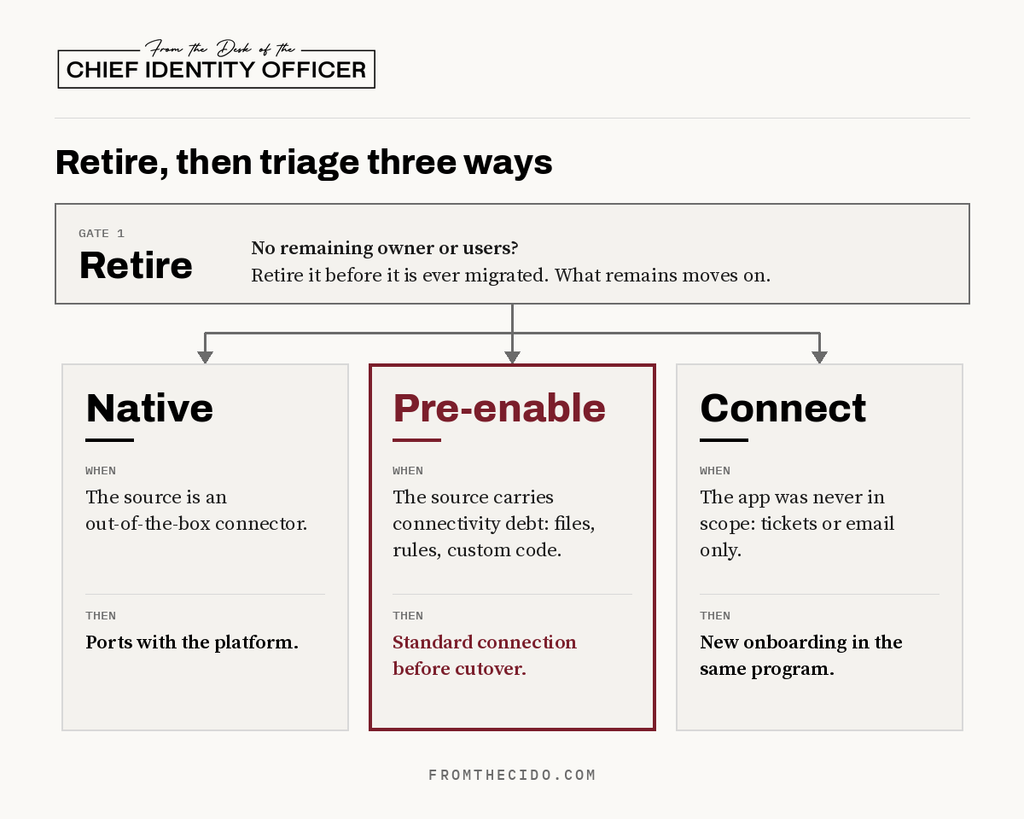
Retire, then triage three ways
Before the SOW is signed, sort every source. Retire what nobody uses first. AWS’s migration guidance makes Retire one of its seven strategies, for “applications that you want to decommission or archive” (AWS Prescriptive Guidance). Then run the three-way triage on what remains:
- Native. A SailPoint out-of-the-box connector exists. Leave the app on it; it ports with the platform. SailPoint’s library offers connectivity to “over 1,200 applications” (SailPoint 10-K, FY2026), so this bucket is broad.
- Pre-enable. The app runs on a flat file, connector rules or custom code. Put it on a standard connection, such as SCIM 2.0, while it still runs on IdentityIQ and before cutover. The IdentityIQ SCIM 2.0 connector supports account create, update and delete, plus group operations (SailPoint docs). Pre-enabled does not mean identical afterward. Human Fabric offers two SCIM 2.0 source types: the SaaS connector lists no Delete Account and no account-group create, update or delete (SailPoint docs), while the virtual-appliance SCIM 2.0 connector lists account deletion (SailPoint docs). Pick the source type per app, and decide now which lifecycle events need another path. No connector code gets rebuilt, but the source still gets configured and tested.
- Connect. The app was never connected and lives in tickets and email. Bring it into scope inside the same program, as new onboarding. Weigh connectivity layers like StackBob.ai to build SCIM connectors for any application ahead of the migration (StackBob), or SailPoint’s Connectivity Agent for “straightforward SaaS applications with well-documented REST APIs” (SailPoint Community).
To make this concrete
Take a hypothetical regulated enterprise with 140 IdentityIQ sources, plus 60 apps managed only through tickets.
| Source type | Count | Bucket |
|---|---|---|
| AD, Entra, Workday, ServiceNow, SAP and other out-of-the-box connectors | 70 | Native |
| Delimited-file apps (aggregation only; changes via work items) | 35 | Pre-enable |
| JDBC apps with provisioning or build-map rules | 15 | Pre-enable (validate each) |
| Custom Java connectors | 8 | Pre-enable |
| Apps with no remaining owner or users | 12 | Retire |
| Apps handled only by tickets or email (not in IdentityIQ) | 60 | Connect |
Half the IdentityIQ sources move on their own. Fifty-eight carry connectivity debt. Sixty were never in scope. A lift-and-shift reports 140 sources moved and leaves those 58 on manual tasks, rules and custom code, with 60 apps still outside governance. The triaged program moves 128 sources, lands 58 of them on a standard connection, retires 12 and brings 60 into scope.
“Apps moved” is a project metric. “Apps governed after cutover” is a program outcome, and it is the number your board should see.
“Don’t refactor mid-migration”
The strongest objection is AWS’s own guidance: “Refactor is not recommended for large migrations because it involves modernizing the application during the migration.” Its alternative: “Instead, we recommend rehosting, relocating, or replatforming the application and then modernizing the application after the migration is complete.” (AWS Prescriptive Guidance)
That is sound advice. The answer is sequencing. Pre-enable happens before cutover, on the platform you run today, so the migration carries a standard connection instead of re-plumbing a live dependency mid-flight. Connect is new onboarding, not a refactor of anything already running. The risk in “modernize after” is that after has no budget line. Put it in the SOW and it gets one.
Your next step
Run the triage on your own source list. Export the IdentityIQ sources, add every app that lives only in tickets, retire what has no owner, and tag the rest native, pre-enable or connect. Then price the pre-enable and connect buckets in the SOW before you sign.
Pre-enable and connect are connectivity work, best scoped before the migration. SailPoint’s Unified Platform Access program gives technology partners direct access to the platform to build integrations for specialized systems (SailPoint, June 2026). Outside that program, StackBob is one vendor working on this. For the connect bucket, it takes SCIM operations from Human Fabric (StackBob help center), applies them in apps that lack SCIM or APIs (StackBob), and lets SailPoint aggregate those accounts back (StackBob help center). Disclosure: I’m Co-founder and CEO of StackBob.
The scoreboard changes
Today the market counts migrations. SailPoint reports that “more than two-thirds of migrations completed in the quarter included an AI-driven solution” (SailPoint 8-K, Q2 FY27). That is the right number for a vendor’s quarter. A customer’s board needs a different one.
My prediction: the IdentityIQ migrations that report success in 2027 and 2028 will be measured on coverage gained, not on cutover dates hit. The programs that triaged before they signed will have that number. The rest will have a go-live date and the same long tail on a newer platform.
Migrate the platform, not the plumbing.
References
- “SailPoint IdentityIQ 9.0: a modern foundation for the world’s most complex enterprises” — SailPoint blog (Jerry Aubel) — 2026-10-06 — https://www.sailpoint.com/blog/sailpoint-identityiq-9-0-a-modern-foundation-for-the-world-s-most-complex-enterprises
- “SailPoint Agentic Acceleration transforms cloud modernization into rapid deployments” — SailPoint press release — 2026-06-16 — https://www.sailpoint.com/press-releases/sailpoint-agentic-acceleration-transforms-cloud-modernization
- “SailPoint (SAIL) Q4 2026 earnings call transcript” (Brian Carolan, CFO; call held 2026-03-18) — The Motley Fool — 2026-06-02 — https://www.fool.com/earnings/call-transcripts/2026/06/02/sailpoint-sail-q4-2026-earnings-transcript/
- SailPoint Q2 FY27 earnings call coverage (Brian Carolan, CFO; Motley Fool transcript republished) — Webull — 2026-09-09 — https://www.webull.com/news/15551770243936256
- SailPoint Q2 FY27 results, Form 8-K Exhibit 99.1 — SailPoint / SEC EDGAR — quarter ended 2026-07-31 — https://www.sec.gov/Archives/edgar/data/2030781/000162828026061015/sailpointinc-20260731x991x.htm
- SailPoint Form 10-K, fiscal year ended 2026-01-31 — SailPoint / SEC EDGAR — 2026 — https://www.sec.gov/Archives/edgar/data/2030781/000203078126000003/sail-20260131.htm
- “Implementing custom connectors” — SailPoint documentation — accessed 2026-11-06 — https://documentation.sailpoint.com/connectors/custom_source_config/help/idn_custom_connector_configuration/implementing_custom_connectors.html
- “Provisioning” (Identity Security Cloud) — SailPoint documentation — accessed 2026-11-06 — https://documentation.sailpoint.com/saas/help/provisioning/index.html
- “Task Manager” — SailPoint documentation — accessed 2026-11-06 — https://documentation.sailpoint.com/saas/user-help/task_manager.html
- “SaaS Connectivity” — SailPoint Developer documentation — accessed 2026-11-06 — https://developer.sailpoint.com/docs/connectivity/saas-connectivity
- “SCIM 2.0 SaaS connector — supported features” — SailPoint documentation — accessed 2026-11-06 — https://documentation.sailpoint.com/connectors/saas/scim_2_0/help/saas_connectivity/scim_2_0_saas/supported_features.html
- “SCIM 2.0 connector (virtual appliance) — supported features” — SailPoint documentation — accessed 2026-11-06 — https://documentation.sailpoint.com/connectors/scim_2_0/help/integrating_scim2/supported_features.html
- “IdentityIQ SCIM 2.0 connector — supported features” — SailPoint documentation — accessed 2026-11-06 — https://documentation.sailpoint.com/connectors/identityiq/scim_2_0/help/integrating_scim2/supported_features.html
- “Provisioning with IdentityIQ” — SailPoint documentation — accessed 2026-11-06 — https://documentation.sailpoint.com/identityiq/help/provisioning/index.html
- “New Identity Security Cloud connectivity simplifies onboarding” — SailPoint Community blog — 2026-04-17 — https://community.sailpoint.com/blog/New-Identity-Security-Cloud-connectivity-simplifies-onboarding
- “Introducing the connectivity agent for simplified web services” — SailPoint Community blog (vivek_shrivastava) — 2026-07-27 — https://community.sailpoint.com/blog/Introducing-the-connectivity-agent-for-simplified-web-services
- “SailPoint launches Unified Platform Access to fuel partner innovation” — SailPoint press release — 2026-06-16 — https://www.sailpoint.com/press-releases/sailpoint-launches-unified-platform-access-to-fuel-partner-innovation
- “Why you should migrate from IdentityIQ to SailPoint Identity Security Cloud” — SailPoint blog (Chris Gossett) — 2023-12-07 — https://www.sailpoint.com/blog/why-you-should-migrate-from-identityiq-to-sailpoints-identity-security-cloud
- “Beyond the lift-and-shift: architecting success in the IIQ to ISC migration” (Developer Days 2026 session abstract) — SailPoint Developer Community — 2026-05-20 — https://developer.sailpoint.com/discuss/t/beyond-the-lift-and-shift-architecting-success-in-the-iiq-to-isc-migration/209983
- “Guidance on migrating from IdentityIQ (IIQ) to Identity Security Cloud (ISC)” (Muhammad Mustafa, 2025-06-19; Chris Shields, 2026-05-21) — SailPoint Developer Community — 2025-06-19 / 2026-05-21 — https://developer.sailpoint.com/discuss/t/guidance-on-migrating-from-identityiq-iiq-to-identity-security-cloud-isc/144977
- “Which IIQ capabilities were the hardest to replace in ISC?” — SailPoint Developer Community — 2026-08-27 — https://developer.sailpoint.com/discuss/t/for-organizations-that-have-migrated-from-identityiq-iiq-to-identity-security-cloud-isc-which-iiq-capabilities-were-the-hardest-to-replace-in-isc/220277
- “IGA, App Proliferation, and the App Integration Chasm” (ESG/Omdia research) — Dark Reading (Todd Thiemann, Omdia) — 2025-11-14 — https://www.darkreading.com/identity-access-management-security/identity-governance-administration-app-proliferation-app-integration-chasm
- “About the migration strategies” (the 7 Rs) — AWS Prescriptive Guidance — accessed 2026-11-06 — https://docs.aws.amazon.com/prescriptive-guidance/latest/large-migration-guide/migration-strategies.html
- “Set up SCIM provisioning from SailPoint” (Identity Security Cloud, SCIM 2.0 SaaS source) — StackBob help center — accessed 2026-11-06 — https://help.stackbob.ai/en/articles/17085173-set-up-scim-provisioning-from-sailpoint
- StackBob company overview (product claims as stated by StackBob) — StackBob — 2026 — https://www.stackbob.ai


