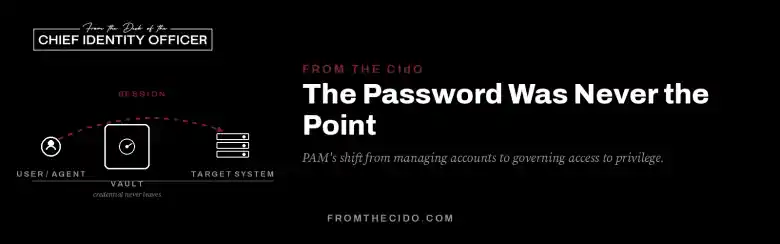
We built Privileged Access Management to lock up passwords. The passwords were never the point.
For most of PAM's life, the job description read like a vault clerk's: discover the privileged accounts, pull the credentials into a hardened store, rotate them on a schedule, and hand them out through check-in / check-out. That work is real, and it still matters. But if your PAM program ends where the vault ends, you have secured the secret and left the far more dangerous thing — the use of that secret in a live session — governed by nothing but trust.
That is the gap. And it is the reason a program full of vaulted, rotated, perfectly-audited credentials can still fail the moment someone actually logs in.
Why this is urgent now
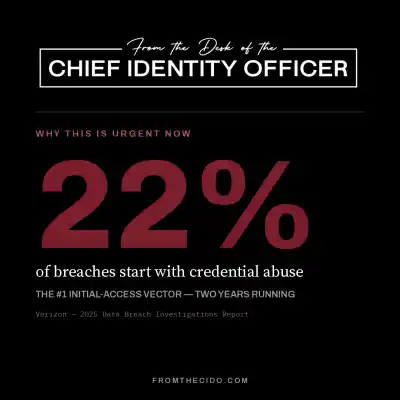
Start with the threat data, because it settles the argument fast. Verizon's 2025 Data Breach Investigations Report puts credential abuse as the number-one initial-access vector for the second year running (22%), with stolen credentials involved in 32% of breaches and 88% of basic web-application attacks. A vault protects the credential at rest. None of those breaches happened at rest. They happened in use.
The analyst framing has already caught up to this. Summaries of the 2025 Gartner Magic Quadrant for PAM split the market into core functions — account lifecycle, credential management, session management — and modern capabilities: privileged remote access, workload identity and secrets, just-in-time (JIT) access, and cloud infrastructure entitlement management (CIEM). Read that structure carefully. Credential vaulting has been reclassified as table stakes. The differentiation — the part vendors are competing on — has moved entirely into governing use.
So let me name the reframe the rest of this piece runs on.
Managing privileged accounts vs. governing access to privilege
Old PAM secured the account. Modern PAM secures the use of privilege — for whoever, or whatever, needs it. The secret can stay locked in the vault while a human, a contractor, or an AI agent is granted a brokered, recorded, time-boxed session and never sees the credential at all.
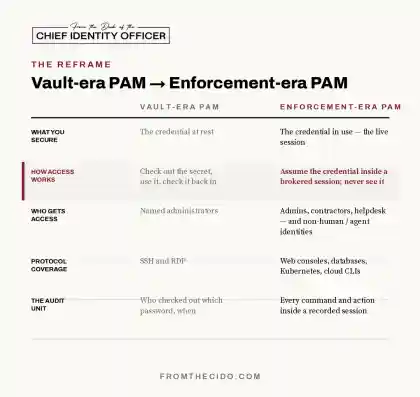
That is not a tuning change. It is a different job. Here is the shift, row by row:
| Vault-era PAM | Enforcement-era PAM | |
|---|---|---|
| What you secure | The credential at rest | The credential in use — the live session |
| How access works | Check out the secret, use it, check it back in | Assume the credential inside a brokered session; never see it |
| Who gets access | Named administrators | Admins, contractors, helpdesk — and non-human/agent identities |
| Protocol coverage | SSH and RDP | Web consoles, databases, Kubernetes, cloud CLIs |
| The audit unit | Who checked out which password, when | Every command and action inside a recorded session |
The mechanism that makes the whole right-hand column possible is credential injection through a secure session broker. CyberArk's Privileged Session Manager, for example, acts as a proxy and jump host: it injects the credential into the session so the user never sees or types it, isolates the endpoint from the target, and records the session to a tamper-evident store. The secret never leaves the vault. The user gets the access, not the password.
The credential you never hand out
Make it concrete. A helpdesk contractor needs to fix a domain-joined server. Under the old model you either hand them a privileged credential (and pray) or wall them off entirely. Under the session-broker model there is a third door: the proxy authenticates the contractor, injects the domain-admin credential into an isolated session, records every action, and revokes access at disconnect. The contractor did the work. The contractor never saw the password. This is exactly the pattern Gartner now files under Remote PAM — session brokering with dynamic credential injection so the remote user never sees, copies, or handles the actual administrative passwords.
Now change one word. Swap "contractor" for "AI agent." The architecture does not change at all.
That is not a thought experiment — three market leaders shipped it inside a single quarter. BeyondTrust (Sep 16, 2025) added secure MCP orchestration with zero standing privilege and JIT for agents; Delinea (Sep 26) released an open-source MCP server that hands agents temporary tokens, never the raw secret; CyberArk Secure AI Agents (announced Nov 4, GA Dec 2025) built agent-identity controls on zero standing privilege and full lifecycle. Three independent vendors, one quarter, the same answer: an agent doesn't need your password — it needs a session it can inherit and then be disconnected from.
Why does this matter beyond novelty? Because the scale is not human-shaped. Estimates of the machine-to-human identity ratio exceed 80 to 1 (CyberArk's 2025 Identity Security Landscape) — the figure is vendor-sourced and methodology-dependent, so hold the exact multiple loosely. The direction is not soft: non-human identities already outnumber humans by an order of magnitude, and CyberArk's CISO research finds fewer than one in ten organizations have deployed agentic security controls at scale even as agent adoption is projected to reach 76% within three years. You do not vault-and-rotate your way through that. You broker sessions.
PAM is a triad problem, not a product
Here is the part most programs skip. Session governance is not something PAM does alone — it is the enforcement edge of the IGA / AM / PAM triad.
- IGA decides who is entitled and owns it. Business and HR policy — the role, the joiner/mover/leaver event, the certification — determines who should assume a given privilege. That is why certified PAM↔IGA integrations are sold as best practice: SailPoint and CyberArk manage the lifecycle of safes and accounts and pull privileged access into enterprise access certifications, and BeyondTrust markets a certified SailPoint integration for the same. Be honest, though: this is target-state architecture, not universal reality — many shops still silo PAM and IGA, and the integration burden is real.
- Access Management enforces how they get in. Authentication is a gate, not the whole control. Modern AM applies per-session and step-up MFA and reads context — device posture, location, behavior — to shorten windows or restrict actions in real time. Policy, not just a successful login, decides what the session may do.
- PAM governs how the entitlement is used in the session — injection, isolation, recording, and revocation.
The failure mode is running all three as silos. The strength is the seam.
What to do if you're a vault-only shop
If your PAM program today is discovery, vaulting, rotation, and check-out — and stops there — you are not failing. You have built the floor. But the floor is not the building. In order:
- Add session brokering and credential injection so privilege is assumed, not handed out. This is the single highest-leverage change.
- Extend coverage past SSH and RDP. Your consumers work in web consoles, databases, Kubernetes, and cloud CLIs; tools like StrongDM and Teleport broker access across all of them with short-lived credentials. Govern the protocols your users actually use, not just the two administrators used in 2010.
- Wire PAM to IGA so entitlement flows from governed business policy and privileged access lands in your certifications.
- Push authentication and context to AM — per-session MFA, JIT elevation, zero standing privilege.
- Design for agents now. They are a new consumer of the same session-broker architecture, not a separate project.
The stake
The question that used to define a PAM program was "where are your privileged credentials?" Vault them and you passed. That question is now the entry fee, not the exam.
Here is my prediction, on the record: by the end of 2026, "can it govern an agent's session?" is a standard line in every serious PAM RFP — right next to session recording and JIT. The industry has already answered how agents should get privilege, and it answered in one quarter with one word: a session, never the secret.
Stop managing privileged accounts. Start governing access to privilege. The account was never what you were protecting — the use of it always was.
References
- Verizon — 2025 Data Breach Investigations Report (DBIR) — Verizon — 2025-04-23 — https://www.verizon.com/business/resources/reports/2025-dbir-data-breach-investigations-report.pdf
- "Inside the 2025 Gartner Magic Quadrant for PAM: What Security Leaders Should Know" — Version-2 (summarizing Gartner) — Nov 2025 — https://version-2.com/en/2025/11/inside-the-2025-gartner-magic-quadrant-for-pam-what-security-leaders-should-know/
- "Session Isolation & Access Control" — CyberArk — accessed 2026-08-02 — https://www.cyberark.com/solutions/session-isolation-and-access-control/
- "What is Remote Privileged Access Management (RPAM)?" — Cyolo (citing Gartner RPAM definition) — 2025 — https://cyolo.io/blog/what-is-remote-privileged-access-management-rpam
- "Remote Privileged Access Management (RPAM)" — Keeper Security — accessed 2026-08-02 — https://www.keepersecurity.com/solutions/remote-privileged-access-management/
- "BeyondTrust Delivers Identity Security Controls for AI" — BeyondTrust — 2025-09-16 — https://www.beyondtrust.com/press/identity-security-controls-for-ai
- "Delinea releases free open-source MCP server to secure AI agents" — Help Net Security — 2025-09-26 — https://www.helpnetsecurity.com/2025/09/26/delinea-free-open-source-mcp-server/
- "CyberArk Introduces First Identity Security Solution Purpose-Built to Protect AI Agents with Privilege Controls" — CyberArk — 2025-11-04 (GA Dec 2025) — https://www.cyberark.com/press/cyberark-introduces-first-identity-security-solution-purpose-built-to-protect-ai-agents-with-privilege-controls/
- "Securing AI agents: privileged machine identities at unprecedented scale" — CyberArk — 2025 — https://www.cyberark.com/resources/blog/securing-ai-agents-privileged-machine-identities-at-unprecedented-scale
- "Integrating SailPoint with CyberArk PAM (Self-Hosted)" — SailPoint — accessed 2026-08-02 — https://documentation.sailpoint.com/connectors/cyberark_pam_selfhosted/help/integrating_cyberark_pam_selfhosted/intro.html
- "BeyondTrust Announces PAM Integration with SailPoint Identity Security Cloud" — BeyondTrust — accessed 2026-08-02 — https://www.beyondtrust.com/press/beyondtrust-announces-pam-integration-with-sailpoint-identity-security-cloud
- "What is Just-in-Time (JIT) Access?" — BeyondTrust — accessed 2026-08-02 — https://www.beyondtrust.com/resources/glossary/just-in-time-access
- "The CISO and CIO's Guide to Modern PAM in 2025: From Vaults to Zero Trust" — Balkan.id — 2025 — https://www.balkan.id/buyers-guide/privileged-access-management
- "StrongDM vs. Teleport" — StrongDM — accessed 2026-08-02 — https://www.strongdm.com/comparison/strongdm-vs-teleport


